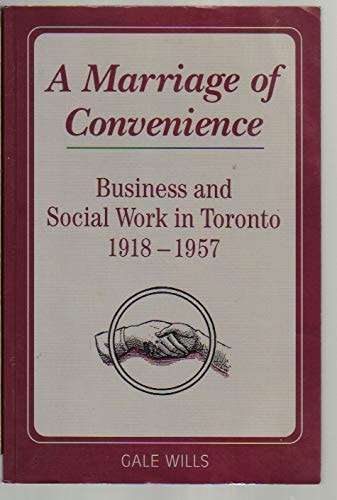
In this study Gale Wills explores questions of corporate control of, and resistance to, the welfare state, the role of the Community Chest as an agent of that control, and the gendered nature of social planning. Specifically, Wills analyses the conflicts between the social reform organizations in Toronto and the financial federations that provided their funds. These include the Child Welfare Council (1918-37), the Toronto Welfare Council (1937-57), the Federation for Community Service (1918-44), and the Community Chest (1944-57) – predecessors of the present-day Social Planning Council and United Way of Metropolitan Toronto. All of these early organizations were at the centre of collective action by the emerging profession of social work and of the philanthropic community. As collective organizations, they brought together a cross-section of social workers and businessmen, which drew attention to differences within the profession as well as between social work and business. The gendered nature of the relationships that evolved is rooted in the fact that the ranks of social work are overwhelmingly female, and the funding bodies and hierarchy of the profession are male. The eclipse of women in power politics, according to Wills, arose from a basic conflict of priorities within the welfare system. Women leaders concerned themselves with social reform, challenging the concerns for efficiency and enhancement of the system’s legitimacy. Following the Second World War, in a climate increasingly favourable to corporate values, men took up public positions in the community, primarily in planning and fund allocation. Women became confined to the domestic sphere of case work.
Reviews
There are no reviews yet.
Be the first to review “Marriage of Convenience: Business and Social Work in Toronto, 1918-1957”Cancel Reply
To provide the best experiences, we use technologies like cookies to store and/or access device information. Consenting to these technologies will allow us to process data such as browsing behavior or unique IDs on this site. Not consenting or withdrawing consent, may adversely affect certain features and functions.
Functional
Always active
The technical storage or access is strictly necessary for the legitimate purpose of enabling the use of a specific service explicitly requested by the subscriber or user, or for the sole purpose of carrying out the transmission of a communication over an electronic communications network.
Preferences
The technical storage or access is necessary for the legitimate purpose of storing preferences that are not requested by the subscriber or user.
Statistics
The technical storage or access that is used exclusively for statistical purposes.The technical storage or access that is used exclusively for anonymous statistical purposes. Without a subpoena, voluntary compliance on the part of your Internet Service Provider, or additional records from a third party, information stored or retrieved for this purpose alone cannot usually be used to identify you.
Marketing
The technical storage or access is required to create user profiles to send advertising, or to track the user on a website or across several websites for similar marketing purposes.



Reviews
There are no reviews yet.